

FAQ: Quality Damage and Falling Numbers 2026
Due to the excessive rainfall in recent weeks, we have begun to see a drop in grain quality in the form of low falling numbers. Below is a short FAQ on what to expect from Crop Insurance, but feel free to call if you have any other questions or want clarification.
It is always important to report a claim if you suspect damage, but it is vital to turn it in early when the damage is related to quality. Samples for low falling numbers can be taken from the bin, but please call ASAP if you suspect a problem. 800-660-8674
Will I collect on a claim if I have low falling numbers?
The likelihood of an indemnity is a difficult question when it comes to quality damage. However, there is no downside to turning in a claim, so please call if you suspect an issue. 800-660-8674
The ultimate factors in whether or not you collect is the number adjusted bushels harvested and the final harvest price. The price that you are able to sell your crop for is not relevant. This is particularly painful for wheat growers, as one bushel of milling wheat is the same as one bushel of feed wheat in the eyes of the insurance policy.
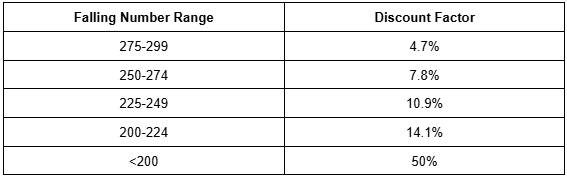
Depending on the type and amount of quality damage, the number of gross bushels you harvest will be reduced. The chart below breaks down the discount ranges for falling numbers. Bushels start to be reduced if the range is below 300 and are reduced as much as 14.1% if the wheat tests between 224-200. If it tests below 200, the reduction caps out at 50%.
However, keep in mind that you will still have to be under your guarantee in order to collect. If you’re guaranteed 45 bu/acre but your wheat harvest is averaging 100 bu/acre, even a 50% reduction won’t push you into a loss scenario.
Should I keep my wheat in the bin or sell it?
If you sell your wheat before a claim is finalized and it is docked for falling numbers, the adjuster will use what is called Reduction in Value to reduce the bushels harvested. If the mill is paying $4.00/bu for feed wheat and reduces you $0.40 due to falling numbers, the adjuster will reduce those bushels by 10% ($0.40/$4.00 = 0.10 → 10%). The fact that it’s feed wheat and going for much less than milling wheat does not matter.
If you hold on to your wheat and wait to sell it until after the claim is finalized, the adjuster will use the applicable discount factor shown in the table above.
This can lead to different scenarios that are difficult to predict. If you hold your wheat to wait on testing and it comes back with minor quality issues, you may suffer when you do sell if prices have dropped at the mill. However, if you sell and the mill only docks you 10% but your falling numbers are below 200, our production will only be reduced 10% whereas it would have been reduced 50% if you’d held onto the wheat until after the claim is finalized. Then you could sell the wheat after you collect and it would not affect the indemnity.
It’s impossible to say for certain what the best course of action is. My advice is to turn in a claim quickly or take a sample to the Mill or Extension to get an idea of your wheat’s quality. If you have high yields with falling numbers in the 200’s and the mill is offering a good price, it may be wise to sell. If you are seeing average or low yields, or your falling numbers are below 200, consider holding your wheat until your claim is finalized.
Feel free to call us (800-660-8674) or your adjuster with these questions. We may not be able to give you a hard recommendation, but we should be able to tell you if you’re looking at no claim, a small claim, or a large claim based on your yields and the sampled quality.
What if I have quality damage that isn’t Falling Numbers?
All quality discounts are applied similarly to Falling Numbers. Depending on the amount of damage, the gross bushels still in storage at the time the claim is finalized are reduced following RMA’s published discount factor charts. Call us or your adjuster for details on discount factors for different damage types. Sold production will be reduced based on the reduction in value.
For products containing toxic substances like aflatoxin, samples must be taken before the grain goes into storage!IT IS VITALLY IMPORTANT TO REPORT A CLAIM AS SOON AS YOU SUSPECT OR DISCOVOR DAMAGE. Wheat containing Vomitoxin may be sampled from the bin, BUT ALL OTHER TOXINS MUST BE SAMPLED BEFORE THE GRAIN GOES INTO STORAGE!!!
A note about quality claims.
When there is widespread quality damage and sampling is needed, there are always rumors of agents or adjusters telling growers to pull their own samples or put some grain in a bucket for the adjuster to pick up later. THIS IS NOT AN ACCEPTABLE FORM OF SAMPLING and a review revealing that it had taken place could result in a claim being turned down, or in the farmer having to pay back money for a claim that had already been paid.
If you are told to pull your own samples, call your agent and request that samples are pulled by the adjuster. We all know how important timing is for wheat harvest and late bean planting, and no one wants to leave strips or slow down while they wait for samples to be pulled. However, the inconvenience of leaving strips is significantly better than your claim being denied, or worse, owing money back.
As always, call if you have any questions. 800-660-8674
Foothills Crop Insurance is a family owned insurance agency with over 85 years of combined experience. We’re experts in tailoring policies to fit grower's operation and budget. Contact us today, and let our family take care of you like you’re one of us! 800-660-8674